
Hangbo Alloy Group
Shanghai · Est. 2012
Weld heat tint on nickel alloys is oxidation that locally strips chromium and molybdenum from the surface. This guide shows how to detect it, why grinding alone fails, and the PO clauses that make pickling mandatory before you accept the weld.
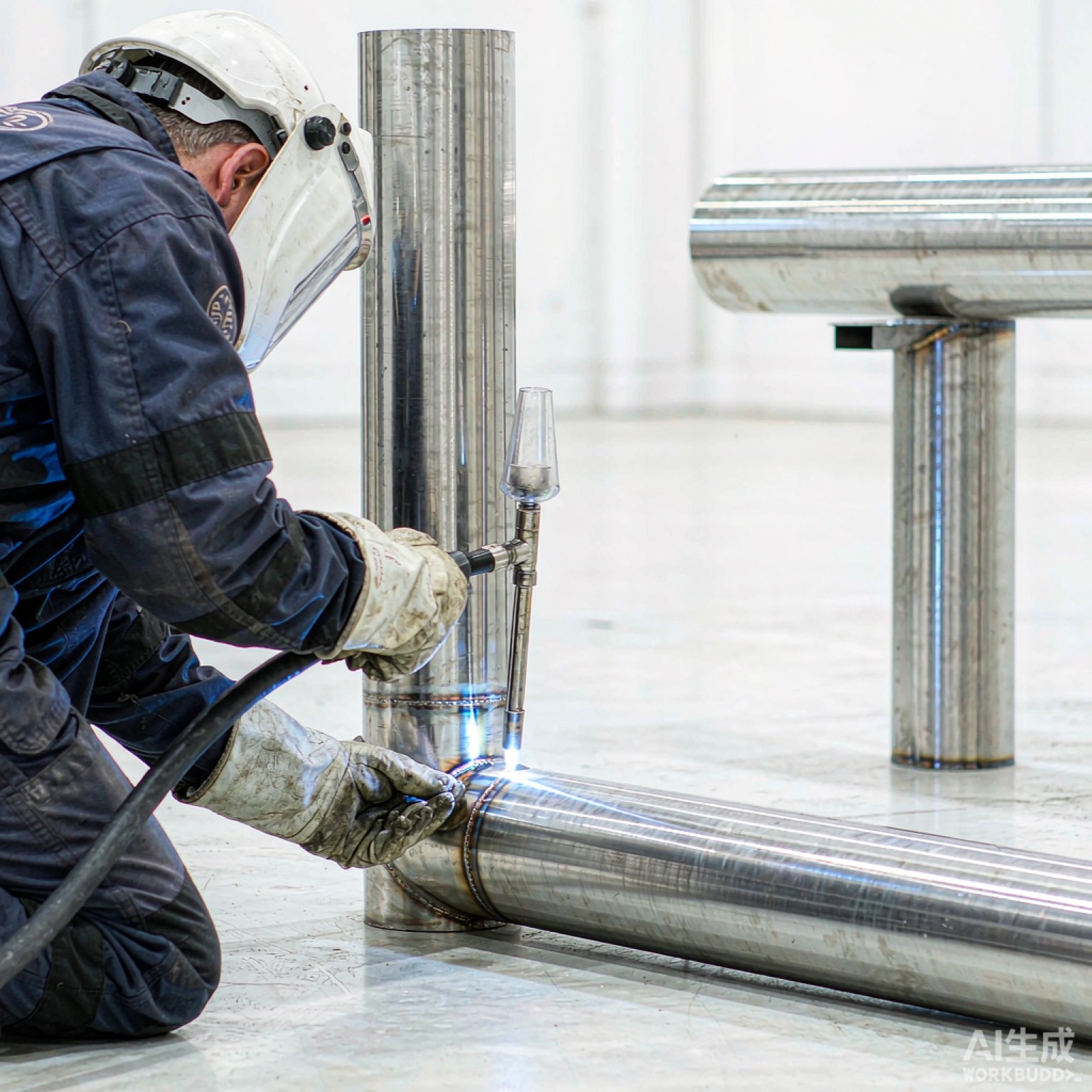
Quick answer: Weld heat tint is the coloured oxidation film that forms on the heat-affected zone of a nickel-alloy weld when the hot metal meets air or damp gas during welding. It looks cosmetic, but the oxide is rich in the very chromium and molybdenum that give the alloy its corrosion resistance, so leaving it on locally weakens the surface exactly where the part meets acid or chloride. The trap is that many suppliers call discolouration “appearance only” and ship it; in aggressive service that discoloration becomes a corrosion-initiation site.
Most procurement teams never see heat tint as a line item. A weld is judged by its radiographic result, its dimensions and its chemistry, and the rainbow film along the bead is waved through as cosmetic. For nickel alloys carrying chromium, molybdenum, niobium or titanium, though, the same film quietly removes the protective elements from the first few microns of surface and can seed pitting or crevice attack within the first service year. The failure then reads as “the alloy failed” when the real story is “the weld was never properly purged or pickled.”
We are a Shanghai-based nickel-alloy producer rather than a trading warehouse, so we see both sides of this issue. Every heat begins with 100% prime virgin feed, is refined through vacuum induction melting together with electroslag or vacuum-arc remelting, is completely descaled before forming, is worked by conventional forging, rolling and grinding, is heat-treated to the named specification, and is released only after chemical, mechanical, NDT and dimensional verification with full heat-number traceability back to the melt. Our aim is to show the three checks — purge, pickling, verification — that keep a weld’s corrosion resistance intact from our dock to yours.
Quick answer: Heat tint is a thin oxide scale grown on the weld and adjacent metal while it is hot; its colour maps to oxide thickness, and because the oxide preferentially consumes chromium, molybdenum, titanium and niobium, the metal directly beneath it is left leaner in those elements. The thicker and darker the tint, the more the surface corrosion resistance has been locally reduced.
Nickel alloys resist corrosion because of a thin, self-healing chromium-rich oxide on their surface. When the weld pool and the neighbouring metal are above roughly 500°C and exposed to oxygen or water vapour, that protective film is replaced by a much thicker, mixed oxide that draws chromium, molybdenum, titanium and niobium out of the underlying metal to form. Those are precisely the elements that fight pitting, crevice corrosion and acids, so their local depletion is far from cosmetic.
The visible colour is simply a thickness indicator. A pale straw film is a few tens of nanometres; a blue or violet film is roughly an order of magnitude thicker; a dark grey or black film means the surface has been significantly oxidized. None of this shows on a weld’s tensile report, which is exactly why it slips through unless the purchase order specifically governs it.
| Element pulled into the oxide | Why it matters for corrosion | Effect of local depletion at the surface |
|---|---|---|
| Chromium | Forms the passive film that resists general and pitting corrosion | Surface loses its first line of defence; pitting can initiate |
| Molybdenum | Drives resistance to pitting and crevice attack in chlorides and acids | Local PREN drops; the area behaves like a leaner alloy |
| Titanium / Niobium | Stabilize the structure and resist sensitization in stabilized grades | Localized microstructural and corrosion weakness |
| Aluminium / Titanium (oxide formers) | Contribute to high-temperature scale adherence | Brittle scale that spalls and traps chlorides |
The takeaway is that the oxide is not a harmless stain; it is the corrosion-resisting elements of the alloy, relocated to the surface and locked into a brittle film that also holds moisture and salt against the metal.
Quick answer: Heat tint forms whenever hot weld metal is not kept in a clean inert blanket. The usual causes are an absent or failed argon root purge inside pipe and tube, air drawn in at the start and stop of a weld or at tack joints, damp or contaminated purge gas, a missing trailing shield, and welding in a draughty or oxidizing environment. Every one of these is controllable at the procedure stage.
Gas tungsten arc welding of nickel alloys is normally done with argon shielding over the visible (cap) side and a separate argon purge inside the joint for the root side. If the root purge is omitted, leaks, or is displaced when the root pass is laid, the inside surface of the weld oxidizes while it is still hot and no operator ever sees it from the outside. The same happens at every arc start and stop, at tack welds, and wherever the trailing shield is skimped on long passes. Damp purge gas or an air-leaking line adds water vapour that oxidizes even faster than dry air.
The prevention is procedural and cheap compared with the consequence: a monitored argon purge with an oxygen analyser reading in the low tens of parts per million, a verified leak-tight purge enclosure, a trailing shield sized to the pass, and a welding bay protected from drafts. The nickel-alloy welding guide covers the joint-prep and shielding discipline buyers should expect from a competent fabricator, and it is worth reading before you approve a welding procedure specification.
| Cause | How it shows | How to detect | How to prevent |
|---|---|---|---|
| No or failed root purge (pipe/tube) | Heavy internal oxidation invisible from outside | Bore-scope the root; require purge records | Monitored argon purge with O₂ analyser < 50 ppm |
| Air entrainment at start/stop, tacks | Localized dark tint at craters and tacks | Full visual of starts/stops; WPS review | Purge continuity; back-purge at stops; skilled operators |
| Damp or contaminated purge gas | Widespread pale-to-blue tint | Gas-line moisture check; purge O₂ log | Dry, high-purity argon; validated gas lines |
| Missing trailing shield | Tint along long cap passes | Visual; request shielding setup photos | Trailing shield sized to the weld pass |
| Draughty / oxidizing bay | Inconsistent, windward-side tint | Site weld inspection | Enclosed, draft-free welding area |
Quick answer: The colour of the film is a rough proxy for oxide thickness: straw and yellow are the thinnest, blue and violet are thicker, and grey-to-black is the thickest and most damaging. As a practical rule for aggressive service, anything darker than a light straw on a molybdenum-bearing grade should be removed, because the underlying metal has lost the most corrosion-resisting elements.
The bands below are not precise measurements — exact thickness depends on alloy, peak temperature and exposure time — but they give an inspector a consistent language at goods-in and final acceptance.
| Colour band | Approx. oxide thickness | Recommended action | Relative corrosion risk |
|---|---|---|---|
| Pale straw / faint yellow | ~20–50 nm | Acceptable for mild service; remove for aggressive duty | Low |
| Gold / brown | ~50–100 nm | Remove by pickling for acid or chloride service | Moderate |
| Blue / violet | ~100–200 nm | Pickle; re-inspect to uniform matte | High |
| Grey | ~200–400 nm | Pickle; verify no residual tint | High |
| Dark grey / black | > 400 nm | Pickle and re-analyze; consider rejection | Very high |
For chromium-only grades such as Inconel 600 the tolerance is a little wider than for the molybdenum-bearing grades, but the principle holds: the darker the film, the more protection has been stripped from the surface. The decisive step is not the colour reading itself but what the specification does about it, which is covered in the removal section.
Quick answer: Detection starts with the naked-eye colour chart, but because colour is subjective and the worst oxidation is often on the unseen root side of pipe, verification should add an oxide-thickness or surface-composition check and a controlled pickling-and-reinspect step. An oxygen analyser during purging catches the problem before it forms.
Visual colour assessment is fast and cheap and catches the obvious blues and greys on the cap side. Its weakness is subjectivity and the fact that the inside of a pipe or tube cannot be seen at all. Surface analysis — X-ray photoelectron spectroscopy, Auger, or a scanning-electron-microscope energy-dispersive scan — measures actual oxide thickness and shows whether chromium and molybdenum have been depleted at the surface, but these are laboratory tools, not goods-in checks. The practical plant-level verification most owners rely on is to require chemical pickling and then re-inspect: a properly pickled surface returns to a uniform matte finish, whereas a ground-only surface keeps a faint tint and an iron-rich smear.
A molybdenum-bearing grade such as 625 that has been grit-blasted in a mixed shop can also carry embedded free iron, which a ferroxyl or copper-sulphate test will reveal. There is no single ASTM method written specifically for nickel-alloy weld tint, so specifiers normally adapt the AWS D18.2 discoloration chart and tie acceptance to removal by pickling under ASTM A380 or A967 rather than to a colour alone.
| Method | What it finds | When to use it |
|---|---|---|
| Visual colour chart | Thickness band by colour on visible surfaces | Routine goods-in and final visual acceptance |
| Bore-scope of root | Internal oxidation on pipe/tube root passes | Mandatory for any internally purged weld |
| XPS / Auger / SEM-EDS | Actual oxide thickness and Cr/Mo depletion | Disputes, failure analysis, qualification |
| Pickle-and-reinspect | Residual tint or iron smear after “cleaning” | Default verification; proves real removal |
| Ferroxyl / CuSO₄ test | Embedded free iron from mixed-shop blasting | Where shared blasting is a risk |
Quick answer: The most dangerous heat tint is the kind nobody sees: root-side oxidation inside pipe and tube where no purge was used, start/stop crater oxidation, and tint that was “cleaned” by grinding alone and left with embedded iron and a thin adherent oxide. Each of these passes a casual visual and then corrodes in service.
The inside of a welded tube is the classic blind spot. The external bead can be bright and perfect while the internal root is heavily oxidized because the purge was skipped or failed; in acid or seawater service that internal film is exactly where flow and crevice conditions attack first. Start/stop craters and tack welds are the second blind spot — short, easy to overlook, and often heavily tinted. The third is the “cleaned by grinding” repair, which leaves a thin adherent oxide and, in a shared shop, drives carbon-steel grit into the surface.
| Failure mode | Where it hides | Consequence | How to detect | How to prevent |
|---|---|---|---|---|
| Root-side oxidation | Inside pipe/tube, never seen outside | Internal pitting in acid/sea service | Bore-scope; purge O₂ records | Monitored argon root purge |
| Start/stop crater tint | Arc starts, stops, tacks | Localized early attack | Full visual of starts/stops | Back-purge at stops; WPS control |
| Grind-only “clean” | Surface looks bright | Residual oxide + embedded Fe | Pickle-and-reinspect | Prohibit grind-only in PO |
| Mixed-shop iron smear | Blasted in shared area | Galvanic / pitting sites | Ferroxyl / CuSO₄ test | Dedicated nickel-alloy area |
| “Cosmetic” acceptance | Written off as appearance | Service corrosion blamed on alloy | Review acceptance criteria | Acceptance tied to pickling |
None of these are caught by a radiographic report or a tensile certificate, which is why the requirement has to live in the welding procedure and the purchase order rather than in a hope that the inspector notices. The procurement pitfalls guide collects the broader class of “you can’t see it on paper” risks that this one belongs to.
Quick answer: The only reliable way to restore corrosion resistance is chemical pickling that dissolves the oxide and the element-denuded layer and re-exposes fresh alloy. Grinding alone is not acceptable because it leaves a thin adherent oxide and can embed iron; a combined mechanical-plus-chemical route is the standard.
Mechanical methods — wire brush, blast, or grind — knock off the loose, thick scale and improve appearance, but they cannot remove the adherent thin oxide that is bonded to the denuded metal, and on a shared line they readily embed carbon-steel particles. Chemical pickling with a nitric-and-hydrofluoric acid mixture (or a citric-based formulation for grades sensitive to fluoride) dissolves that oxide and the depleted layer together, re-exposing a chromium-rich surface. For the most aggressive duties the two are combined: brush or blast the loose scale first, then pickle to finish, then re-inspect to a uniform matte.
The specification language that protects the buyer is simple and absolute: “all weld-metal discolouration shall be removed by pickling per ASTM A380/A967; grinding-only removal is not accepted.” Without that sentence, a fabricator is free to call the tint cosmetic and ship it. For molybdenum-rich alloys such as C-276 and for C-22, where the molybdenum is doing the heavy lifting against acid and chloride (see our PREN and pitting-resistance guide), this clause is not optional.
Quick answer: Put four things in writing: name the root shielding gas and an oxygen-monitor limit for purging; require that all weld discolouration be removed by pickling per ASTM A380/A967 with no grinding-only acceptance; require a post-weld pickling step in the welding procedure specification; and require visual acceptance of both root and cap before final release. Vague “clean weld” wording leaves the loophole open.
A workable clause set reads approximately as follows: root and cap sides of all nickel-alloy welds shall be shielded with argon of declared purity, with an in-line oxygen analyser reading below 50 ppm before and during the root pass; all weld discolouration shall be removed by chemical pickling in accordance with ASTM A380 or A967, and grinding-only removal is not accepted; the welding procedure specification shall document the purge, trailing shield and post-weld pickling steps; and final visual acceptance of the root (by bore scope where internal) and cap shall be recorded before hydrostatic test and release. For sour or seawater duty, reference NACE MR0175 / ISO 15156 cleanliness expectations explicitly.
Tie the requirement to heat-number traceability so a tinted weld can be traced to its heat and procedure. Our nickel-versus-stainless guide shows how stainless practice (AWS D18.2, ASTM A967) can be borrowed directly for nickel alloys.
| Clause to write | What it prevents |
|---|---|
| Argon root purge + O₂ analyser < 50 ppm on WPS | Unseen internal root oxidation |
| All tint removed by pickling per ASTM A380/A967 | Shipping cosmetic-but-corroding welds |
| Grinding-only removal explicitly prohibited | Residual oxide and embedded iron |
| Post-weld pickling step in the WPS | “We’ll clean it later” gaps |
| Visual acceptance of root + cap before release | Tint signed off as acceptable |
| NACE MR0175 / ISO 15156 cleanliness for sour duty | Chloride attack on tinted welds |
Quick answer: There is no single ASTM written for nickel-alloy weld tint, so owners borrow from stainless practice: the AWS D18.2 discolouration chart for grading, ASTM A380 and A967 for cleaning and passivation, ASTM G1 for cleaning and pickling terminology, ASME Section IX for the purge/backing-gas welding-variable controls, and NACE MR0175 / ISO 15156 where sour service applies. The exact requirement is whatever your purchase order states.
| Document | Covers | Note for buyers |
|---|---|---|
| AWS D18.2 | Stainless-steel welding; discoloration chart | Adapted by specifiers for nickel-alloy tint grading |
| ASTM A380 | Cleaning and descaling of stainless surfaces | Commonly cited for pickling Ni-alloy welds |
| ASTM A967 | Passivation of stainless; verification | Used to confirm the passive film is restored |
| ASTM G1 | Cleaning, descaling and passivation terminology | Defines pickling language |
| ASME Section IX | Welding procedure qualification | Purge / backing-gas are controlled variables |
| NACE MR0175 / ISO 15156 | Sour-service material limits | Often mandates weld cleanliness |
Nickel alloy trade names are third-party trademarks; the governing identity is the UNS number and the ASTM or ASME product and procedure standard, so cite those on the order rather than a brand name alone. A certificate that is silent on weld shielding and pickling has simply not addressed the risk.
Weld heat tint is the coloured oxidation film that appears on and beside a nickel-alloy weld when the hot metal is exposed to air or damp gas during welding. The colour — from pale straw through blue to grey — is a rough measure of oxide thickness. Because the oxide draws chromium, molybdenum, titanium and niobium out of the surface, it is not a harmless stain but a local loss of the elements that give the alloy its corrosion resistance.
For nickel alloys in acid, chloride or seawater service it is a real risk, not cosmetic. The film depletes the protective elements in the first few microns and traps moisture and salt against the metal, so it can seed pitting or crevice attack within the first year of service. In mild, non-aggressive duty a faint straw tint may be tolerable, but the safe default for molybdenum-bearing grades in aggressive environments is to remove it by pickling.
Start with the visual colour chart on any surface you can see, and use a bore scope to inspect the inside of pipe and tube roots, which is where the worst, unseen oxidation hides. For disputes or qualification, surface analysis such as XPS, Auger or SEM-EDS measures actual oxide thickness and elemental depletion. The most practical plant check is to require chemical pickling and then re-inspect to a uniform matte finish, and to log the purge oxygen reading during welding so the problem is prevented rather than found.
No, and this is the most common mistake. Grinding removes the loose dark scale but leaves a thin adherent oxide bonded to metal that has already lost its chromium and molybdenum, and on a shared line it drives carbon-steel grit into the surface. The correct route is chemical pickling per ASTM A380/A967, usually after light mechanical removal of loose scale, followed by re-inspection. Grinding-only removal should be prohibited in the purchase order.
The molybdenum- and niobium-bearing grades suffer the most, because molybdenum oxidizes readily and is exactly what resists pitting and acid attack — C-276, C-22, 625 and similar alloys. Chromium-only grades such as Inconel 600 are somewhat less sensitive but still lose protection, so every nickel alloy in aggressive service needs proper purge and pickling. The grade-specific corrosion guides explain why molybdenum content makes the difference.
Name argon root shielding with an oxygen analyser limit (commonly below 50 ppm) on the welding procedure specification; require that all weld discolouration be removed by pickling per ASTM A380/A967 with grinding-only removal explicitly prohibited; require a post-weld pickling step in the WPS; and require visual acceptance of both the root (by bore scope where internal) and the cap before final release. For sour or seawater duty, reference NACE MR0175 / ISO 15156 cleanliness.
Heat tint is oxidation of the alloy’s own surface elements, while free iron is carbon-steel particles embedded into the surface by grit blasting or shared tooling in a mixed shop. Both worsen corrosion — free iron creates galvanic and pitting sites — and both are addressed by keeping nickel alloys in a dedicated area and by pickling rather than grinding. A ferroxyl or copper-sulphate test reveals embedded free iron specifically.
Strictly, those are stainless-steel references, and there is no nickel-specific ASTM for weld tint. In practice owners adapt the AWS D18.2 discoloration chart for grading and cite ASTM A967 passivation by contract, so the binding requirement is what your purchase order and welding procedure specification state, not the standard’s title. A certificate that is silent on shielding and pickling has simply not addressed the risk.
Heat tint is the weld risk that hides in plain sight, and the cost of ignoring it is corrosion that arrives within the first year and gets blamed on the alloy. Tell us the alloy, the form, the service environment and whether the part will be welded, and we will melt from 100% prime virgin feed, refine through vacuum induction melting with electroslag or vacuum-arc remelting, and deliver material whose fabrication — purge, pickling and verification — you can audit from our procedure to your receiving dock.
Email: [email protected]
Phone: +86-136-1165-6360
WhatsApp: +86 13611656360
Send us the alloy, the form, the service environment and whether the part is welded, and we will melt from 100% prime virgin feed, refine by vacuum induction melting with electroslag or vacuum-arc remelting, and supply material whose purge, pickling and verification you can audit from our procedure to your dock — with heat-number traceability your inspector can re-check.