
Hangbo Alloy Group
Shanghai · Est. 2012
Vacuum-melted, vacuum-cast nickel-base superalloy for turbine blades, vanes and turbocharger wheels, supplied as master alloy ingot or precision investment castings with full heat traceability.
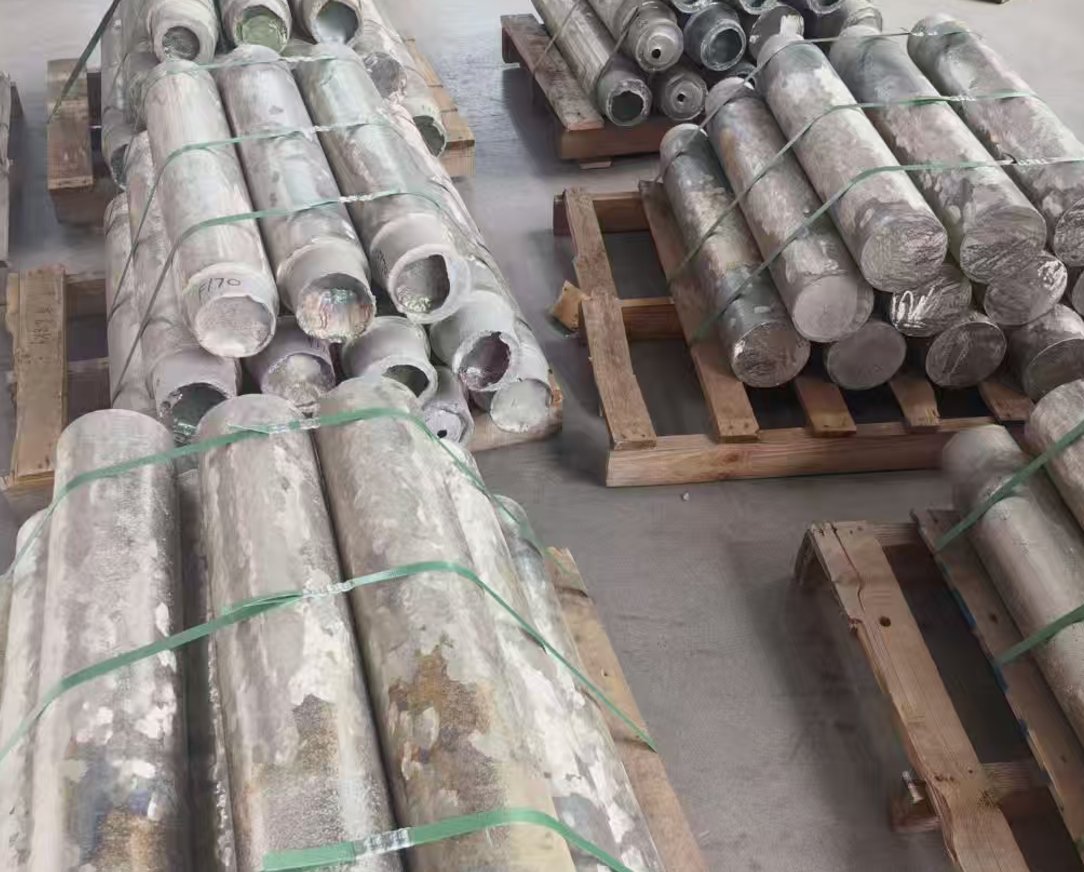
Inconel 713C (IN-713C) is a precipitation-hardened nickel-chromium superalloy that has been the workhorse cast blade alloy of aero and industrial gas turbines for decades. Its strength comes from a very high volume fraction of the gamma-prime phase Ni3(Al,Ti), produced by roughly 5.5–6.5 % aluminium and 0.5–1.0 % titanium, with molybdenum for solid-solution strengthening and niobium for carbide formation and grain-boundary control. The result is an alloy that keeps useful creep-rupture strength to about 980 °C and is used almost entirely in the as-cast condition.
Because of its high gamma-prime content, Inconel 713C is a cast-only alloy: it cannot be forged, rolled or drawn, and it is produced exclusively by vacuum induction melting (VIM) followed by vacuum investment casting. Hangbo Alloy supplies it in two forms — master alloy ingot for foundries and OEMs that remelt and cast in-house, and near-net-shape precision castings produced to your CAD or drawing. A fuller technical discussion sits in our superalloy knowledge centre.
Inconel 713C is supplied to AMS 5377 and AMS 5391 for investment castings, and to ASTM B637 where master alloy or remelt stock is specified. In China the equivalent cast grade is K418 (K18) to GB/T 14992, and the German material number is 2.4671. The low-carbon variant of the same family, Inconel 713LC, is specified where better ductility, weldability and thermal-fatigue life are required.
Two conditions matter on the order line. The as-cast condition is the standard delivery state and carries the full gamma-prime strengthening as-cast. Where maximum creep life or ductility is required, a homogenised and double-aged treatment (solution at roughly 1180–1220 °C, then ageing at about 930–950 °C and 760–780 °C) is applied. Because thick castings crack under water quenching, all heat treatment is air-cooled or furnace-cooled.
| Element | Ni | Cr | Mo | Al | Nb (Cb) | Ti | C | Zr | B | Fe | Si | Mn |
|---|---|---|---|---|---|---|---|---|---|---|---|---|
| Range (wt%) | Bal | 12.0–14.0 | 3.8–5.2 | 5.5–6.5 | 1.5–2.5 | 0.5–1.0 | 0.08–0.20 | 0.05–0.15 | 0.005–0.015 | ≤2.5 | ≤0.50 | ≤0.25 |
Reference chemistry to AMS 5377 / AMS 5391 and UNS N07713. Individual heats are certified on the mill test certificate.
| Property | Value (as-cast) |
|---|---|
| Tensile strength, room temperature | 900–1100 MPa |
| Yield strength (0.2%), room temperature | 700–850 MPa |
| Elongation, room temperature | 5–10% |
| Stress-rupture life, 980 °C / 152 MPa | ≥ 30 h |
| Hardness (as-cast) | 33–37 HRC |
| Density | 8.0 g/cm³ |
| Melting range | 1295–1345 °C |
| Magnetic | Non-magnetic (austenitic) |
Master alloy ingot. Vacuum induction melted remelt stock and foundry ingot, typically 75 mm and 90 mm diameter sticks or cut lengths, with chemistry certified against AMS 5377 and the customer's own specification. This is the preferred input for foundries running their own investment-casting or directional-solidification lines.
Precision investment castings. Near-net-shape castings produced from your CAD or pattern, covering equiaxed grain and, where specified, directionally solidified (DS) structure. Typical parts include turbine blades and vanes, integral turbine and turbocharger wheels, nozzle guide vanes, shroud segments and hot-section structural components with thin walls and internal cooling passages.
Post-processing. Hot isostatic pressing (HIP) is available to close casting porosity and lift high-cycle fatigue life; radiographic (RT) and fluorescent penetrant (FPI) inspection are standard on rotating components, and machining of cast parts is performed with carbide and PCD tooling to a controlled window.
Every shipment carries an EN 10204 3.1 mill test certificate stating heat number, full chemical analysis including niobium, titanium, boron and zirconium, the heat-treatment condition and the results of tensile and stress-rupture testing. EN 10204 3.2 independent verification and third-party inspection through BV, SGS, TUV or DNV are available. Our quality system is certified to ISO 9001:2015 and GJB 9001C, and we can hold master alloy against your release schedule so casting runs never wait on material.
Send us your casting drawing or master alloy specification — grade, weight, quantity and any DS or HIP requirement — and our team responds within 10 minutes during business hours.